

What arrives on the desk
A PDF from the customer's own ERP, a spreadsheet a buyer maintains by hand, a scan of a marked-up quote, or a plain email body listing six lines and a promised date. Frequently all four from the same customer in the same month.
What makes this vertical different
These are the details that decide whether an order is right, and the ones that generic document automation treats as ordinary text.
Per M and per C will cost you a hundredfold, not a percent
Fastener quantities and prices are routinely quoted per thousand (M) and per hundred (C). A line reading 5M at $42.50/C is five thousand pieces priced per hundred. Read M as the customer's shorthand for each, and you have shipped five pieces against an order for five thousand — or the reverse. This is the single most expensive silent failure in fastener order entry, and it is why FrontBeacon shows the conversion arithmetic on screen rather than performing it invisibly.
The pack is not the unit
A box of 100, a carton of 5,000, a keg of hex nuts. The customer orders in one and your item master holds another, and the conversion depends on the SKU rather than on a general rule. FrontBeacon blocks a line whose pack semantics cannot be resolved instead of defaulting it to each.
Plating, finish and grade live in free text
Zinc, hot-dip galvanised, black oxide, Grade 5 versus Grade 8, and a dozen customer-specific abbreviations for each. The same nominal size in a different finish is a different SKU and a different price, and the distinction is usually buried in a description field rather than a part number.
Certifications turn a line into a document request
A line requiring mill certs or a certificate of conformance is not just an item — it carries paperwork obligations. FrontBeacon flags the requirement onto the draft rather than dropping it, because it is the kind of detail that gets missed in re-keying and discovered at delivery.
What we do not do
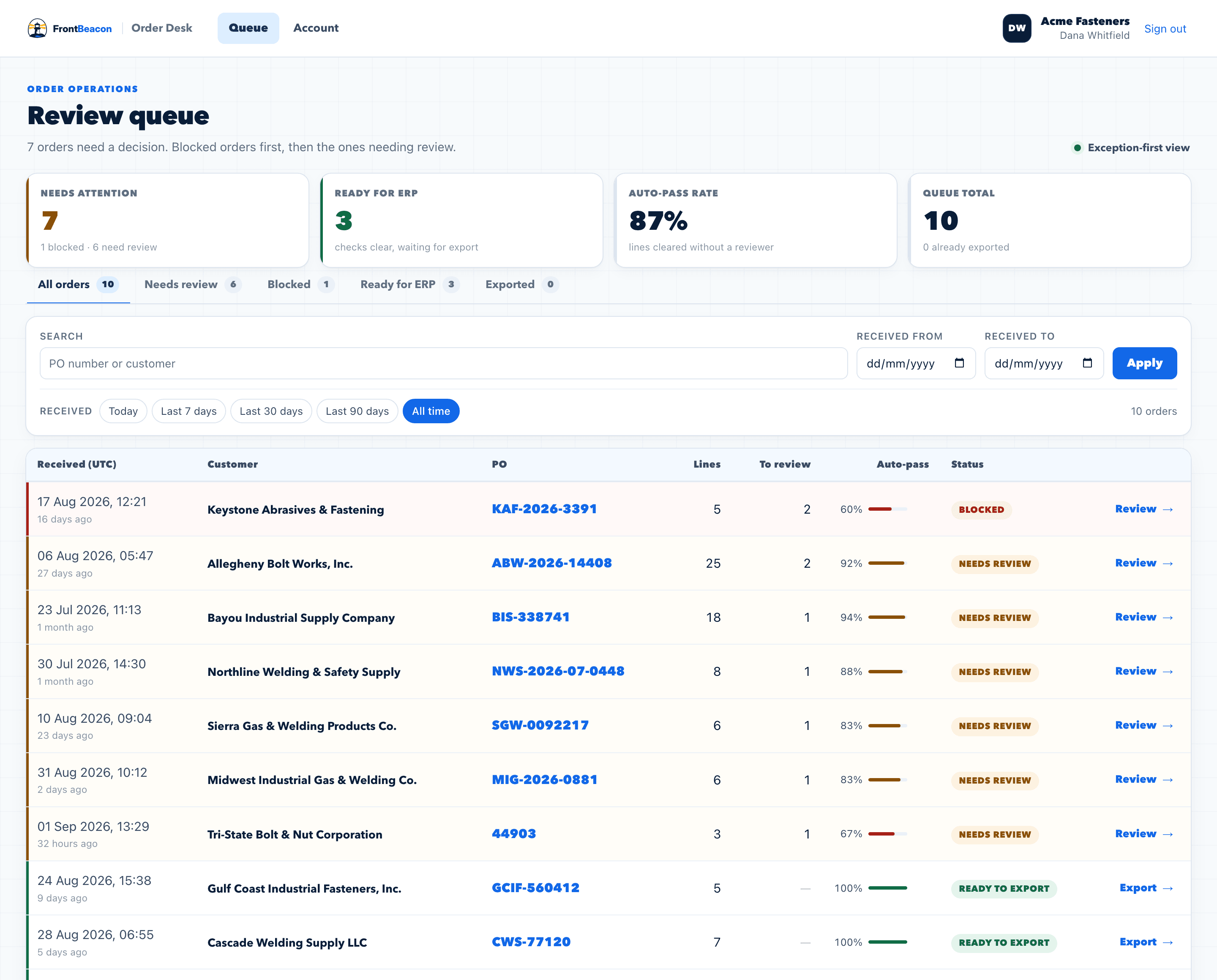
FrontBeacon prepares the order. Your ERP stays authoritative for pricing, credit, availability, tax and freight, and a person on your desk approves every order before it becomes an import file. We do not release orders, choose substitutions, or make commercial decisions on your behalf.
Common questions
- We use customer part numbers constantly. Does that break it?
- It is the main thing it is built for. A reviewer confirms once that a given customer's reference means a given SKU, and that alias is remembered for that customer only. One buyer's shorthand never contaminates another's, which matters when two customers use the same abbreviation for different items.
- What happens with a unit we have never seen?
- The line blocks and says so. FrontBeacon does not default an unrecognised unit of measure to each. An order with one blocked line does not become an import file until a person resolves it.
- How much emailed volume makes this worth doing?
- The honest threshold is where emailed orders are a daily named task rather than an occasional interruption. Below that the arithmetic does not work and we will say so on the call.
Common ERPs in this vertical
- The Business Edge handoffOrder-entry automation for fastener distributors running The Business Edge — emailed POs turned into a reviewed, import-ready sales order.
- Prophet 21 handoffTurn emailed purchase orders into Prophet 21 sales orders through SISM, without an API licence or an EDI project.
- Inform ERP handoffEmailed purchase orders into DDI System's Inform ERP as reviewed sales orders, without an ecommerce or EDI project.
- ERP-ONE handoffOrder-entry automation for distributors running Distribution One's ERP-ONE, from emailed PO to reviewed sales order.